
Macro Panel vs Handcam Aim: Which Lands More Headshots?
Every Free Fire lobby has two kinds of demons: the panel user and the handcam grinder. One tunes sliders and lets software sharpen the drag. The other posts handcam videos proving every headshot came from raw thumbs. Both claim superiority. This guide settles it honestly: what each approach actually does to your aim, where each one wins, and which one fits your playstyle. If you go the panel route, start from the official Macro Panel download page.
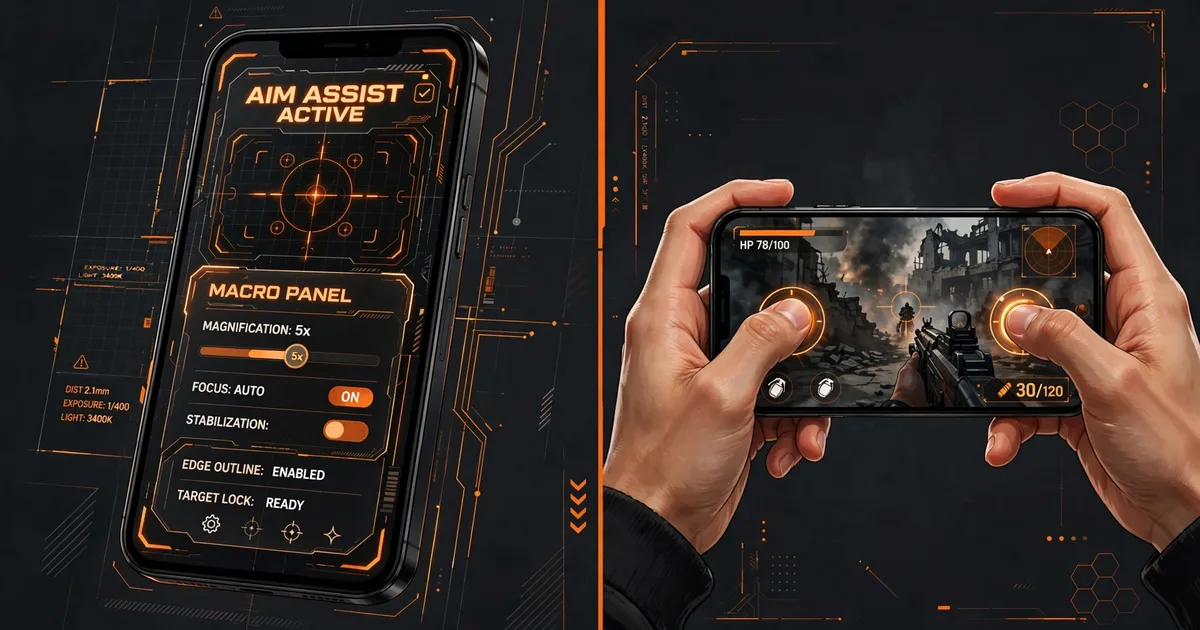
First, definitions so we argue about the same thing. A macro panel like Macro Space v5 adjusts sensitivity curves, DPI behavior, and overlay assists around your drag. Handcam aim means no panel at all, just in-game sensitivity and thousands of hours of thumb training, usually recorded with a camera pointed at the player's hands as proof. Our review team, led by Viktor Kane, tested both approaches across 200 ranked matches to compare them fairly.
Key takeaways: Panels raise your floor fast: most players see better drag consistency within days. Handcam grinding raises your ceiling higher over months, with zero ban risk. Panels carry real account risk, handcam carries none. Pick the tradeoff you can live with.
What a macro panel actually does to your aim
A panel does not aim for you, despite what both its fans and its haters claim. What Macro Space v5 does:
- Sensitivity curves per scope. Finer control than the in-game sliders, tuned per weapon class.
- Drag smoothing. Small assist on the drag path that keeps your flick from wobbling off the head.
- Overlay shortcuts. One-tap toggles for DPI profiles and sensitivity presets mid-match.
The honest effect: your bad days get less bad. Your drag consistency tightens, your worst flicks improve, and you reach a solid headshot rate in weeks instead of months. What it does NOT do: it does not teach game sense, positioning, or timing. A panel user with bad decisions still loses to a smart player.
What handcam grinding actually builds
Handcam players build the same skills with nothing but in-game settings and repetition. The cost is time, the payoff is real:
- True muscle memory. Your thumbs learn the exact drag distance for every range. This transfers to any phone, any account, forever.
- Adaptability. New phone? New update? A handcam grinder retunes in days because the skill lives in their hands, not in software.
- Zero ban risk. There is nothing for anti-cheat to flag. Your account is safe by construction.
- Higher ceiling. The very best drag players in the scene are handcam players, because at the top end, feel beats presets.
The catch is the timeline. Reaching panel-level consistency by hand takes months of deliberate practice. Our headshot tips guide covers the drills either way.
Head-to-head: the honest comparison
| Factor | Macro Panel | Handcam |
|---|---|---|
| Time to decent headshots | Days to weeks | Months |
| Skill ceiling | High, but capped by presets | Highest, limited only by you |
| Ban risk | Real, never zero | None |
| Works after every update | Needs panel updates | Always works |
| Phone switching | Reconfigure the panel | Retune in days |
| Tournament legality | Banned in officials | Fully legal |
The ban risk question, answered straight
This is the real divider. Macro Space is third-party software interacting with your game, and Free Fire's anti-cheat can flag it. Sensitivity-only use sits at the cautious end of the risk spectrum, automated macro actions sit at the dangerous end, but no use case is risk-free. If your account has years of progress and rare items, that risk should weigh heavily.
We break the full risk picture down in Is Macro Space Safe?, read it before you decide. Handcam players skip this entire worry. That peace of mind is worth more than most players admit until they lose an account.
The third option: panel-assisted handcam training
Here is a path few players talk about: use the panel as training wheels, then take them off. Start with Macro Space v5 to feel what clean, consistent drags are supposed to feel like. Pay attention to the drag distance, the speed, the way the crosshair settles on the head. Then, after a month, turn the panel off and reproduce the same drags with pure in-game settings.
Players who do this report something interesting: their handcam aim improves faster than players who never touched a panel, because the panel gave their thumbs a correct reference feeling to chase. It is like training with a metronome and then playing without one. The rhythm stays in your hands.
The practical method: run the panel for 30 days while doing the daily training routine, logging your one-tap rate weekly. Then disable the overlay for two weeks and keep training. If your rate holds within 10 percent, the skill transferred and you can leave the panel behind with zero account risk going forward.
Which should you choose?
- Choose the panel if: you want faster improvement, you play casually or semi-competitively, and you accept the account risk with open eyes.
- Choose handcam if: your account is precious, you dream of tournaments, or you want skill that no update can take away.
- The hybrid path: many strong players start with a panel to learn what good drags feel like, then wean off it. The panel teaches the target feeling, the thumbs keep it.
Either way, the foundation is the same: dial in your sensitivity settings first, because bad sensitivity ruins both approaches equally. The tool changes, the fundamentals do not.