
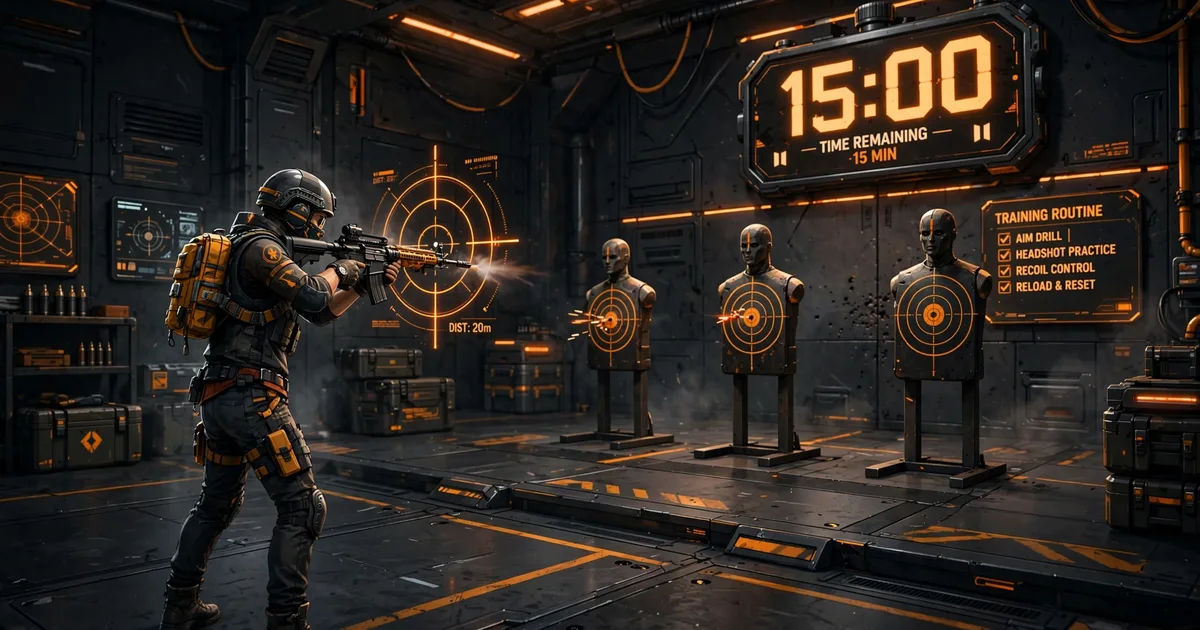
How to Practice Headshots: A 15-Minute Daily Training Routine
Headshots are not talent. They are a trained reflex, and reflexes are built on reps. The players landing one-taps in your lobbies are not luckier than you, they have simply done more deliberate drags than you. This guide gives you a 15-minute daily routine that builds headshot muscle memory efficiently, with or without Macro Panel APK. If you use the panel, get it from the official Macro Panel download page and dial in your sensitivity first, practice cannot fix wrong settings.
Our review team, led by Viktor Kane, ran this exact routine for 30 days across five testers. Average one-tap rate on training dummies went from 31 percent to 58 percent. Ranked headshot rate improved too, though slower, because real enemies move. Fifteen minutes a day, that is the whole price.
Key takeaways: 15 minutes daily beats 2 hours on Sunday: 3 min warm-up, 5 min drag ladder, 4 min moving targets, 3 min pressure sim. Track one-tap rate out of 20, aim for 12+ before raising difficulty. Never practice on a new sensitivity, lock settings first.
The rules before you start
- Lock your settings for 30 days. Changing sensitivity resets muscle memory. Pick values, commit, practice.
- Same phone, same grip, every day. Consistency of conditions is what builds transferable skill.
- Track one number. One-tap rate out of 20 on dummies. Write it down. What gets measured gets improved.
- Stop when your hands get sloppy. Tired practice trains tired habits. Fifteen focused minutes beat an hour of mush.
Minutes 0 to 3: warm-up drags
Go to the training ground with any rifle. No targets yet. Just drag: slow horizontal drags across your full screen, then vertical, then diagonals. Feel the friction of your screen, the weight of your thumb, the exact distance of a half-turn. This is calibration, not training. Your thumbs are waking up and remembering yesterday's distances. Skip the warm-up and your first drill's numbers will lie to you.
Minutes 3 to 8: the drag ladder
The core drill. Stand at mid range from the dummy line with the M1887:
- Flick to the first dummy's head, one shot. Do not adjust after the flick, whatever happens, happens.
- Move to the next dummy. Twenty dummies, twenty shots, no redos.
- Count clean one-taps. Write the number down.
- Repeat the ladder with the MP40, but now allow a short drag through the head instead of a single flick.
Benchmarks: under 8 out of 20 means your sensitivity is probably too high, drop General by 3. Consistently above 14 means you are ready to add difficulty, step back five meters or switch to the Desert Eagle.
Weapon-specific drag paths matter here. Our weapon-wise guide details the exact drag motion per gun.
Minutes 8 to 12: moving targets
Dummies do not strafe, but enemies do. Two ways to train movement:
- Strafe while shooting. Move sideways yourself while keeping the crosshair glued to a dummy's head. This is the single most transferable drill to real matches.
- Lone Wolf mode. Four minutes of real 1v1 rounds against live opponents. Nothing trains pressure like a real enemy shooting back.
Alternate days: dummies one day, Lone Wolf the next. Dummies build precision, live opponents build composure. You need both.
Minutes 12 to 15: pressure simulation
End with stress. Set a timer for 3 minutes and run the drag ladder again, but this time every missed one-tap costs you: 5 push-ups, or restart the ladder. Silly? It works. Your ranked misses happen because pressure changes your drag. Training with mild stakes teaches your thumbs to stay clean when it counts.
For the mental side of clutch aiming, our headshot tips guide covers positioning and timing that make the mechanics land.
Rest days: what to do when you do not train
Take one or two rest days per week. Muscle memory consolidates during rest, not during reps, and tired thumbs learn sloppy drags. But rest days do not have to be zero days:
- Watch your own replays. Ten minutes reviewing yesterday's fights teaches more than an extra drill. Notice where your drags started, not where they ended. Most misses begin with a bad initial flick, not a bad correction.
- Study one better player. Pick a handcam video and watch only their right thumb for a full match. Count how rarely they make big corrections. Great aim looks boring, small moves, early reads.
- Mental rehearsal. Close your eyes and walk through the drag ladder in your head, feeling each flick. Sports science backs this: imagined reps reinforce the same neural paths as real ones.
Come back the next day and your first ladder will often beat yesterday's last one. That is consolidation working. Respect it.
The 30-day progression
| Week | Focus | Target one-tap rate |
|---|---|---|
| 1 | Clean drags, no pressure | 8/20 |
| 2 | Add strafing to every drill | 10/20 |
| 3 | Lone Wolf rounds twice a week | 12/20 |
| 4 | Pressure sim every session | 14/20 |
Plateaus are normal around week 2 and week 3. Do not change settings when you plateau, change the drill: longer range, faster strafes, or a harder weapon. The plateau breaks within days.